
Introduction
Learn how Stackless turns connected business data into governed models, dashboards, and Agent-built analytical artifacts.
What is Stackless?
Stackless is a managed analytics platform for teams that need trusted reporting without running a full internal data stack. Stackless connects business systems, lands the data in a warehouse, transforms it into governed datasets, exposes business metrics through semantic models, and gives users an Agent that can explore, explain, and build analytical outputs.
The important difference is that Stackless is not just a chat box on top of data. The Agent can work across the same layers your data team would use: sources, warehouse tables, transformation models, semantic models, dashboards, and saved artifacts.
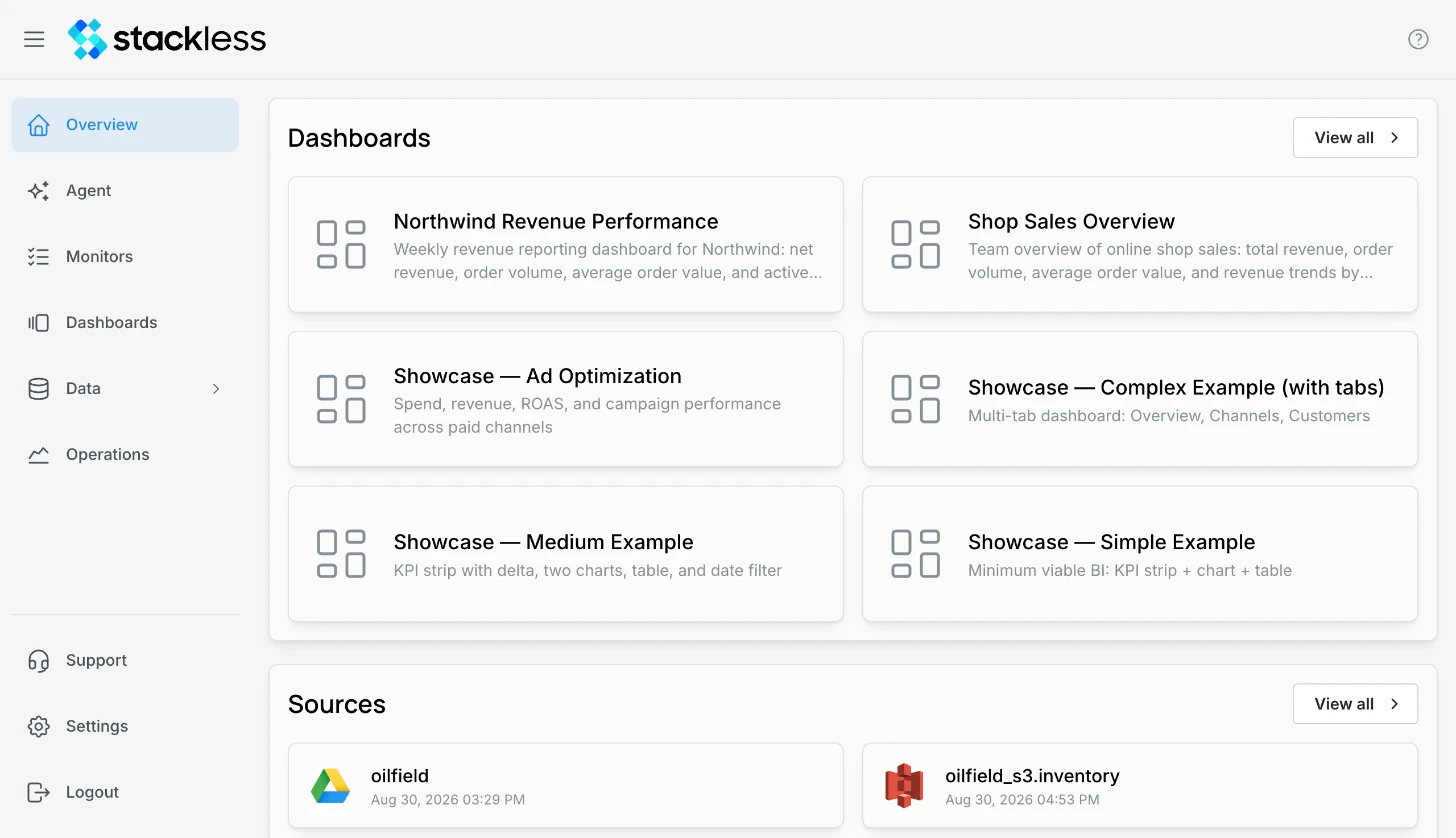
How the platform is organized
Stackless is built around these user-facing areas:
Agent
The Agent is the primary workbench for asking questions, inspecting available data, creating artifacts, and building dashboards. It can answer direct questions, create reusable table and chart artifacts, draft and publish Transformation and Semantic Models after your confirmation, connect sources, and assemble Stackless dashboards.
Dashboards
Dashboards are persistent analytical surfaces for repeated reporting. A dashboard is private while it is being drafted, can be shared privately, and is published to the roles that should see it. Dashboards can include KPI cards, charts, tables, filters, tabs, exports, scheduled email exports, and metric definition drawers.
Monitors
Monitors run a governed analysis or metric check on a schedule or after a dataset refreshes, and deliver the result to Slack, email, or a webhook with a traceable run history. Use them for recurring questions such as "tell me every morning if revenue drops more than 15%."
Data Sources
Sources are the upstream systems Stackless reads from, such as commerce, payments, CRM, marketing, and databases. Sources are added from Data > Sources or through the Agent, using managed connectors with a secure setup page for credentials.
Transformation Models
Transformation Models are managed dbt models. They clean, join, aggregate, deduplicate, flatten, pivot, and otherwise prepare raw warehouse data into reusable tables or views. They are drafted privately, sampled, published, refreshed on a schedule, and exposed to the Catalog.
Semantic Models
Semantic Models define the measures, dimensions, joins, and business names that dashboards and Agent charting use. They should usually sit on top of published Transformation Models, not raw source tables, so dashboards inherit the correct business logic.
Catalog and Operations
The Catalog is the searchable map of visible data assets and lineage. Operations is the technical view of scheduler jobs, model refresh runs, run logs, and failure alerts.
Who this documentation is for
- Operators and managers who use dashboards and want the Agent to answer follow-up questions.
- Business analysts who need to create tables, charts, dashboards, and repeatable reporting.
- Data owners who want to understand transformations, semantic models, lineage, and access.
- Administrators who manage users, roles, data access, Slack, and Agent data visibility.
- Technical stakeholders who need the architecture and security model at a practical level.
Where to start
If you are new to Stackless, start with Quickstart. If you need help, see Getting Help. If you are mainly interested in the Agent, read Agent Overview, Using the Agent, and Artifacts. If you are responsible for governed data models, start with Transformations and Semantic Models.